At fifty applications, screening is a reading problem. You read carefully, you use judgment, you get it roughly right.
At a thousand, it stops being a reading problem and becomes a statistical one. Nobody reads a thousand CVs properly. What actually happens is that the first eighty get real attention, the middle six hundred get eight seconds each, and the last three hundred get skimmed on a Friday afternoon by someone who has already mentally shortlisted.
The candidates you hire from that process are not the best applicants. They are the ones who applied early and used the right words.
Here is what changes at scale, and what to do about it.
Why volume breaks normal screening
Signal-to-noise collapses
Easy applications produce indiscriminate applications. When applying takes one click, candidates apply to everything remotely plausible, which means a 1,000-application pile is not a 200-application pile scaled up — the proportion of genuinely qualified people is usually lower. More volume, worse ratio.
Order effects become severe
A CV read at position 12 and the same CV read at position 780 do not get the same evaluation. Screeners calibrate against what they have already seen and get progressively harsher or more lenient depending on the run of quality. At fifty CVs this is noise. At a thousand it is a systematic bias in favour of early applicants.
Candidates optimise against you
At volume, a meaningful share of applicants are running their own tooling — tailoring CVs to job descriptions automatically, keyword-matching against your ad, sometimes pasting the job description into the CV in white text. Keyword-based filters are close to useless against this, because they reward exactly the behaviour being gamed.
Bias becomes measurable, which cuts both ways
This is the one people miss. At fifty applications, a skewed shortlist is plausibly chance. At a thousand, it is statistically visible — and in jurisdictions with adverse impact rules, visible means actionable. Volume hiring is where inconsistent screening turns into documented legal exposure.
The flip side is that volume also makes screening auditable for the first time. You can actually measure whether your process is doing what you think.
The structural fix: filter before you evaluate
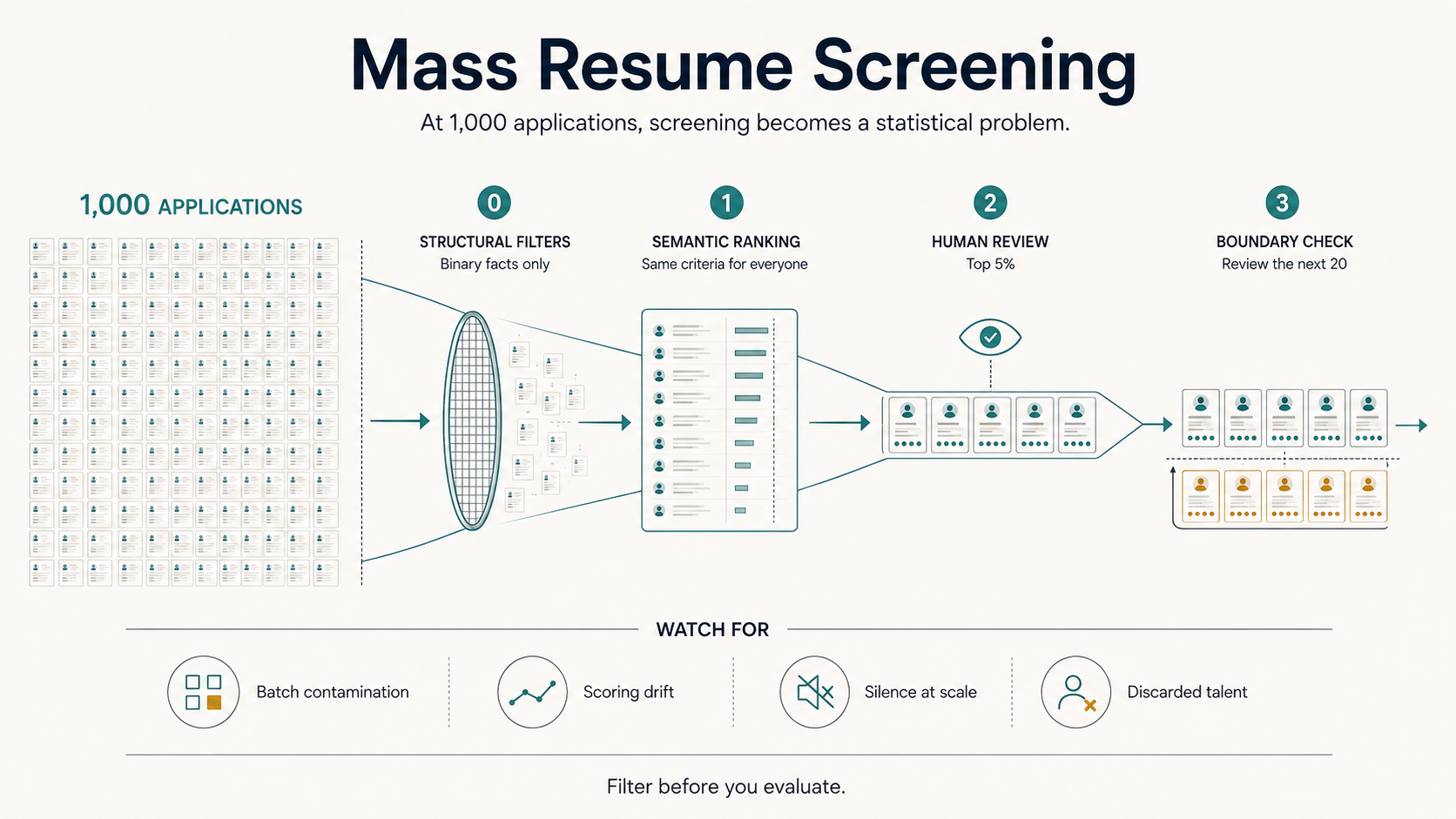
The core mistake in mass screening is treating a thousand applications as a thousand decisions. Split the pile before anyone reads anything.
Stage 0 — Structural elimination (automated, no judgment)
Before any evaluation, remove applications that fail a binary, non-negotiable condition: work authorisation, required licence or certification, location or willingness to relocate, minimum experience threshold, salary expectation outside band.
These are facts, not assessments. Ask them as structured questions in the application form rather than trying to extract them from CVs. Two or three well-chosen questions typically remove 40–60% of a high-volume pile in seconds, and — importantly — they remove it consistently, which a human at CV 780 does not.
One caution: every knockout question should be defensible as a genuine requirement of the job. “Five years’ experience” as a proxy for competence is exactly the kind of filter that produces adverse impact without improving hire quality.
Stage 1 — Automated ranking (machine, all remaining CVs)
Score every survivor against three to five written requirements, using the same scale, in one consistent pass. This is the stage that has to be automated at volume — not because humans are worse at judging a single CV, but because humans cannot apply an identical standard four hundred times.
What matters here is that ranking is semantic rather than keyword-based. Someone who spent four years doing exactly your job but described it in different vocabulary should surface. That single property is worth more at volume than at any other scale, because at volume you will never catch them manually.
Stage 2 — Human review (top 5%)
Fifty CVs, read properly, with actual judgment. This is where the human work should be concentrated, and at a thousand applications it is roughly a day rather than a fortnight.
Stage 3 — Boundary check (the band below your cutoff)
Skip this and you will never find out your process is broken. Take the twenty candidates who scored just below the shortlist threshold and have a human read them. If several are obviously strong, your criteria or your tooling are wrong and you have caught it in time to fix it.
This costs an hour per role and is the single highest-value quality control in volume hiring.
Four failure modes specific to volume
1. Batch contamination
When processing CVs in large batches — particularly through general-purpose AI tools — details bleed between candidates. Person A’s employer gets attributed to Person B; two candidates with similar backgrounds get merged. The error is invisible unless you check output against source documents, and it gets worse as batch size grows. If you are using a tool at volume, ask specifically whether accuracy is measured at 500 CVs or at ten.
2. Scoring drift across batches
If applications arrive over three weeks and you screen in Monday batches, week one and week three need the same scale. Otherwise a candidate’s score reflects when they applied rather than how good they are. Ask any vendor directly: is a score from January comparable to a score from March?
3. Silence at scale
Nine hundred and fifty people get rejected. If they hear nothing, you have generated nine hundred and fifty poor impressions of your employer brand, some of them customers. Automated rejection messaging is not a nicety at volume — it is reputation management. Send it within a week, keep it short, and do not pretend a form email is personal.
4. Discarding the pile afterwards
The payoff from mass screening is largest precisely because the pile is large. Out of a thousand applicants, dozens are hireable for adjacent roles. If your process ends with a hire and an untouched database, you have paid the full cost of volume and taken none of the compounding benefit.
Two requirements to capture it: consent at application time (a single checkbox on the confirmation screen), and a system where past applicants remain semantically searchable rather than sitting in a folder.
What tooling volume actually requires
Most screening tools are built and benchmarked for moderate volume. At 500+ per role, the requirements narrow:
- Genuine batch processing with accuracy validated at your actual volume, not demo scale
- Semantic matching, because at volume keyword filters both miss qualified people and reward gaming
- Stuffing detection — explicit checks for job-description copying and keyword padding, which is common enough at scale to matter
- Stable scoring across batches and across time
- Written reasoning per candidate, because at volume you will eventually need to explain a decision and “the system scored them 42” is not an explanation
- Deduplication, since the same people apply to multiple roles
- Searchable retention of everything processed
CVScanner — full disclosure, we build it — is designed around this list. Batch evaluation with anti-keyword-stuffing validation, vector-based semantic matching, written rationale plus a binary pick / no-pick verdict for fast triage, and a searchable deduplicated database of everything processed. It is a screening layer rather than an ATS, so it sits alongside whatever you use for pipeline management.
The honest test at volume: take a role you have already closed, run the full original pile through, and check two things — whether your actual hire appears in the top 5%, and whether anyone in the top 5% is someone you never reached. The second number is the one that tells you what manual screening was costing you.
Frequently asked questions
How many applications count as high volume?
The methods change somewhere around 200 per role. Below that, a structured three-pass manual workflow holds up. Above roughly 500, manual screening stops being merely slow and starts being systematically inconsistent — the same CV genuinely gets a different outcome depending on when it is read.
Can you screen 1,000 resumes in a day?
Yes, with the staged approach: knockout questions remove most of the pile instantly, automated ranking handles the remainder, and human review concentrates on the top 5% plus the boundary band. What you cannot do in a day is read a thousand CVs, which is why the answer is structural rather than a matter of working faster.
Is automated screening legal for high-volume hiring?
Generally yes for ranking and prioritisation. Fully automated rejection is more restricted — GDPR limits solely automated decisions with significant effects, and several jurisdictions have specific rules for automated employment decision tools, some requiring bias audits and candidate notification. The practical position is to automate ranking and keep a human on rejection decisions. Check your local requirements.
How do you stop candidates gaming keyword filters?
Stop using keyword filters as the primary mechanism. Semantic matching evaluates meaning in context, which is substantially harder to game than string matching, and dedicated stuffing detection catches the common patterns — job description text pasted into a CV, keyword blocks, hidden text.
What should we do with the 950 people we don’t hire?
Reject them promptly and keep them, with consent, in a searchable pool. At volume this is the largest available return: a thousand-applicant pile typically contains dozens of people hireable for adjacent or future roles, already pre-vetted and already interested in you.
Screening at volume? Test CVScanner free on a role you have already closed and see what your manual process missed.